
< Back to Publications & Resources
Patient Portals: Healthcare Communication Boon?
Repurposed from The Scope Q4 2025
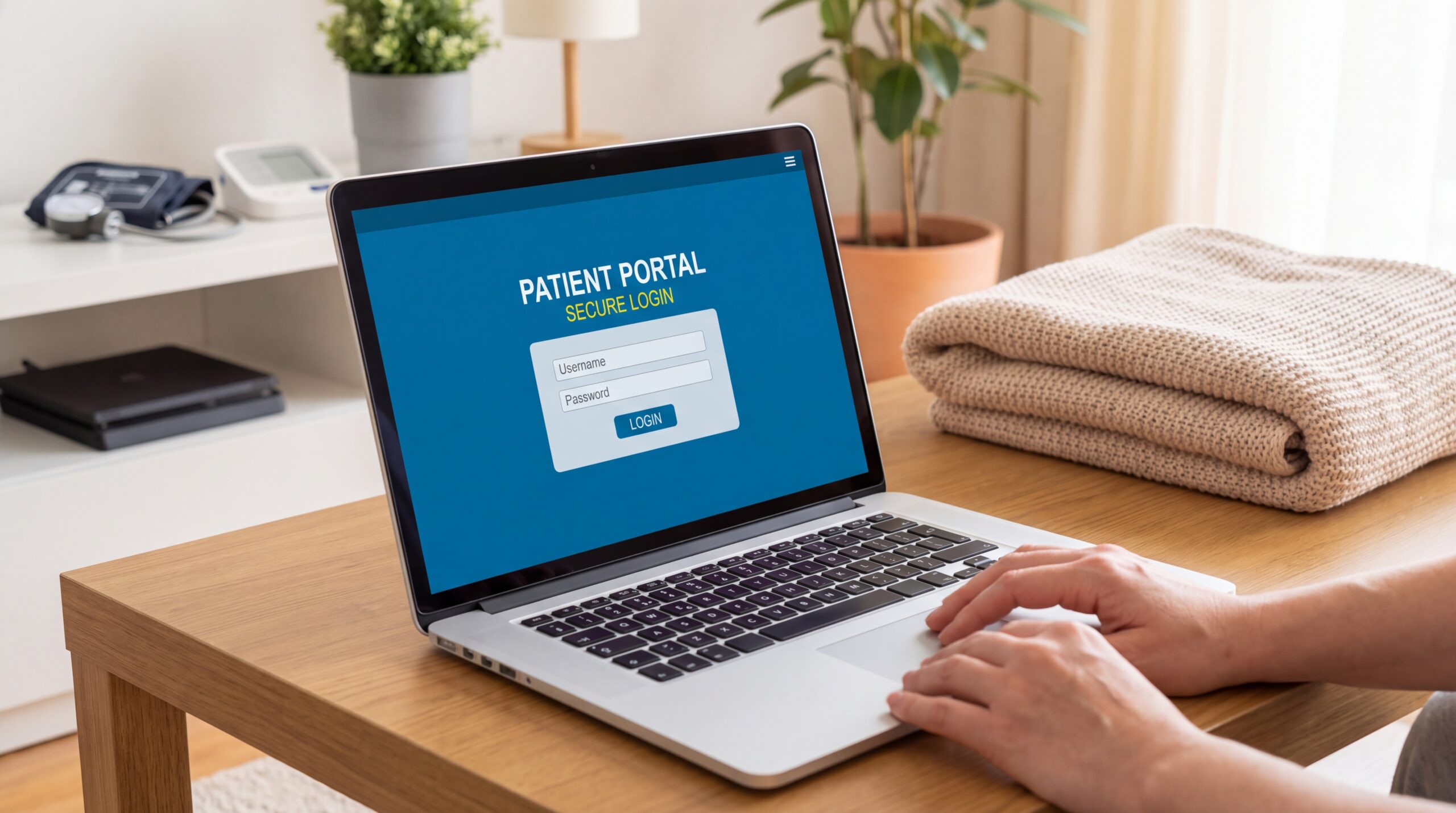
Patient portals are a useful tool to improve patient adherence to treatment plans and generate patient-provider communication, but their low rate of adoption and use, often due to limited access to technology or low technological literacy, can prevent portals from achieving their intended outcomes.1 Moreover, the practice of immediately releasing test results without context provided by clinician counseling is controversial. While patients may be satisfied receiving test results online, portals provide inadequate guidance on interpreting abnormal results, which may contribute to misinformation.2 This article will address these obstacles and offer guidance to improve the patient experience and make portal use by patients more engaging.
Perhaps the biggest advantage of patient portals is the opportunity they provide to increase patient engagement by allowing and encouraging the patient to ask questions and otherwise communicate with their physician in a way that may enhance the physician-patient relationship. Some patients feel a greater sense of control over their communication with their provider, since portals allow the patient and physician to address concerns and process information without feeling hurried or uncomfortable, as is often the case with in-person encounters. Portals also allow the patient to ask a question when it is fresh in their mind, rather than waiting for their next visit. Despite these benefits, portals can come with certain inherent risks. One of these is a patient’s inability to understand the data given on the portal — data they may now be seeing before speaking with their physician, which may increase the patient’s discomfort and worries. There is also the risk of information overload and the potential for misinterpretation of information. This overload can create confusion about managing health, especially for those with chronic conditions who must interpret various test results and medical notes. Providers need to offer clear guidance on how to understand this information and give concise explanations alongside test results or offer a caveat that the doctor will provide context as soon as possible.3 While patients often expect quick responses, providers need time to review and give context. It is important to ensure, at the onset of portal access, that patients understand the portal is not for urgent matters and are encouraged to contact the practice for clarification of any information provided. This message should be periodically reinforced. Practices should consider adding language to their patient encounter forms, reminding patients and their guardians/support persons of what to expect with portal communication. It is crucial that practices make clear to patients that the portal is intended for asynchronous communication and that time is needed to respond to inquiries.
Much like returning telephone calls, practices should have clear policies on response times for portal messages. For example, is a 72-hour response time suitable for your patient population and within the capabilities of the practice? Any stated expected response time should be followed, and the practice should have a metric to measure whether inquiries are addressed within the stated time frames. From a liability perspective, it would be difficult to defend the timing of responses to pertinent portal inquiries that fall outside the practice’s policies. An article in the Journal of the American Board of Family Medicine by S. El‑Toukhy et al. addresses how a patient’s age, education level, and sex may act as barriers to the use of portals. Individuals who lack vocational or high school education or have limited proficiency in English are less likely to use patient portals to access their medical records or communicate with their healthcare providers. Interestingly, El‑Toukhy et al. found that women tend to access portals more than men and suggest this is related to women's tendency to be the primary healthcare decisionmakers for their families. Patient portals offer conceivable opportunities to increase health literacy and potentially achieve better health outcomes for patients by promoting education, self-management, and access to healthcare. Limited health literacy goes hand in hand with poor outcomes, increased expenditures, and health disparities, with studies revealing that at least 88% of adults living in the United States do not have the health literacy required to adequately navigate the healthcare system and promote their well-being. To improve health literacy, there has been growing recognition of the potential of digital communication tools to empower individuals to take a more active role in managing their health.4 Taking the time to educate patients with low health literacy on the benefits of portals and how to access them can only help to improve their health outcomes and enhance their patient experience.
Limited English proficiency is also a barrier to portal use. Practices should inquire with their portal vendor about whether they have translation tools available in their system for languages commonly spoken by the practice’s patient population. If such tools exist, any instructions or notices related to the portal should likewise be translated into those languages. Some studies show that low computer or technological literacy, when patients are not familiar with using smart devices or even the internet, is also a concern. Unfortunately, this has been associated with less awareness, use, and perceived usefulness of portals.5 Along with that, some patients, regardless of health literacy, computer literacy, access to technology, or age, will still find the use of patient portals overwhelming or uninviting because they find the portal impersonal compared to speaking to a human being. While convenient, some patients feel that portals cannot replace face-to-face interactions with their physician or care team. Lack of computer literacy may affect proper logging in and use. For example, older patients may not recall passwords or login procedures for their portal. As with addressing patients with low health literacy, it is important to train staff to be efficient and patient and to offer older patients resources and guidance, such as in-office demonstrations on portal use, to help those patients understand and utilize the portal effectively.
Providers and patients often have conflicting views on how much information needs to be shared with patients. Even the sharing of medical notes might create confusion for patients. When patients get concerned over something they see in their health record, it could result in more phone calls or scheduled visits, even if the information is not of concern.6 Remember that how you document an encounter can have an effect on your patient. When documenting care, be cognizant that your patient will have access to the documentation, so be careful not to sound judgmental in your notes. Avoid terms that may be offensive or emotionally charged. For example, document “Patient reports s/he did not take medications” rather than “noncompliant” or “unreliable.”7
There are subjects that may be inappropriate for the patient to discuss on a portal, especially sensitive issues or concerns, and the patient may not realize that the person who checks the portal may well be office staff and not the physician. This may also hold true for complex information, which the patient may not explain appropriately, making more work for the physician. Be mindful of different patient preferences and digital literacy levels when implementing and promoting the portal and make sure your policies are clear on the role of the portal in the physician-patient relationships.8
Privacy, security, and concerns about data breaches arise with the use of portals. Some patients do not wish to share confidential information and would rather speak directly to the provider. Likewise, a patient’s spouse, caretaker, guardian, or parent may have access to the patient’s portal, and the patient may wish to restrict information shared with such third parties. The concern regarding who can see the protected health information (PHI) is what keeps many individuals from using the portal. It is common knowledge that healthcare institutions are at high risk for cyber security and data breaches, with the patient portal being no exception. Patient portals store sensitive personal and health information; therefore, robust security measures must be in place. Implement security measures to protect PHI. Require strong passwords with multifactor authentication and reset passwords every 90-180 days.
Lastly, patient portals are also grounds for discovery during a malpractice suit. Plaintiff attorneys now routinely demand portal metadata, including when a provider accessed the patient information, what information was accessed, and the length of time the provider spent responding to a patient inquiry. It is recommended that practices learn what type of information would be revealed in an audit trail from their portal vendor before any malpractice claims are asserted against their practice.
In sum, though patient portals are a useful tool for communication between healthcare providers and their patients, they can potentially improve outcomes and enhance the patient experience, not all patients use them due to a wide variety of factors.9 It will take time and perhaps a new generation of computer-literate people to increase the use of patient portals, and perhaps there can be a choice of languages beyond English that might increase portal use.
MLMIC policyholders can reach out to our healthcare attorneys for questions about patient portals or any other healthcare law inquiries by calling (877) 426-9555 Monday-Friday, 8 a.m.-6 p.m. or by email here.
Our 24/7 hotline is also available for urgent matters after hours at (877) 426-9555 or by emailing hotline@tmglawny.com.
Follow us on Facebook, LinkedIn, Instagram or Twitter to stay in the loop about the medical professional liability industry.
If you are not already a MLMIC insured, learn more about us here.
Sources:
- https://www.thieme-connect.com/products/ejournals/abstract/10.1055/s-0043-1770901
- https://jamanetwork.com/journals/jamanetworkopen/fullarticle/2802672
- https://www.simbo.ai/blog/evaluating-the-advantages-and-disadvantages-of-implementing-patient-portals-in-healthcare-practices-1866311/
- https://pmc.ncbi.nlm.nih.gov/articles/PMC10693297/#:~:text=Introduction,health%20(9%E2%80%9312)
- https://pmc.ncbi.nlm.nih.gov/articles/PMC9919456/#:~:text=Conclusions,but%20patients'%20eHL%20did%20not
- https://etactics.com/blog/disadvantages-of-patient-portals#:~:text=Patient%20portals%20are%20set%20up,are%20stuck%20doing%20more%20work
- https://www.mlmic.com/blog/open-notes-in-the-ehr/
- https://www.vozohealth.com/blog/top-4-barriers-to-patient-portal-adoption-in-2021/
- https://www.benchmarksystems.com/blog/advantages-and-disadvantages-of-patient-portals/
This document is for general purposes only and should not be construed as medical, dental or legal advice. This document is not comprehensive and does not cover all possible factual circumstances. Because the facts applicable to your situation may vary, or the laws applicable in your jurisdiction may differ, please contact your attorney or other professional advisors for any questions related to legal, medical, dental or professional obligations, the applicable state or federal laws or other professional questions.


